
How to Choose the Best Water Filter for Safe Drinking Water at Home
- aguabert
- 11 minutes ago
- 10 min read
Clear tap water can still carry things you cannot see, taste, or smell. Chlorine, limescale, lead from old pipework, nitrates, pesticides, bacteria, and microplastics all raise different questions, and no single filter removes everything.
Choosing a water filter is less about buying the most expensive system and more about matching the filter to the water in the home. A family in a hard-water area may need a different setup from a household using a private supply, an older property with lead pipes, or a flat where taste and odour are the main concern.
This guide explains how to test water, understand likely contaminants, compare filter types, and keep a system working safely over time. It is for general information only and does not replace advice from your local water supplier, environmental health team, or a qualified water treatment professional.

Start by finding out what is in your water
The best filter choice begins with a simple question: what are you trying to remove?
Many homes are served by treated mains water, which is monitored by the water supplier. That does not mean every household has the same water quality at the tap. Water can pick up metals from old pipes, develop taste and odour issues, or carry sediment after pipe work in the street.
Homes with private water supplies, such as boreholes, wells, or springs, need closer attention. These supplies can be affected by nearby agriculture, septic tanks, flooding, animal waste, or changes in the surrounding land.
Check your water report
If you use mains water, start with your supplier’s water quality information. It can tell you about:
Hardness levels
Disinfectant use, such as chlorine
General mineral content
Routine test results
Known local issues
This gives a useful baseline. It will not always show what is happening inside the property pipework, especially in older homes.
Test at the tap
Home test strips can give a quick indication of hardness, chlorine, pH, nitrate, and some metals. They are useful as a starting point, but they are not as accurate as laboratory testing.
A certified laboratory test is a better choice if:
The home has old plumbing or suspected lead pipes
Water comes from a private supply
Someone in the household is pregnant, immunocompromised, elderly, or an infant
Water has a persistent smell, colour, or taste
There has been flooding, nearby construction, or a change in land use
You want to confirm whether a filter is working
For private supplies, testing should include microbiological checks as well as chemical tests. Bacteria such as E. coli and coliforms can cause illness, and a standard jug filter will not make contaminated water safe.
Learn which contaminants matter most
Different contaminants need different treatment methods. That is why a filter that improves taste may do very little for lead, nitrates, or microbes.
Here are common water concerns and what they usually mean.
Concern | What it may suggest | Common filter approaches |
Chlorine taste or smell | Disinfection by the supplier | Activated carbon |
Limescale | Hard water minerals | Ion exchange, scale reduction, water softener |
Sediment or particles | Pipe work, maintenance, private supply issues | Sediment filter |
Lead | Older pipework or fittings | Certified carbon block, reverse osmosis, specialist lead reduction filter |
Nitrates | Agriculture, fertilisers, private supplies | Reverse osmosis, specialist nitrate resin |
Bacteria or parasites | Private supply contamination or emergency issue | UV treatment, boiling, certified microbiological filtration |
Pesticides and organic chemicals | Run-off or local contamination | Activated carbon, reverse osmosis |
Salty or high dissolved solids | Mineral content or supply issue | Reverse osmosis |
A common mistake is assuming that “filtered” always means “safe”. A basic carbon jug can make water taste better, but it is not designed to handle serious contamination. If test results show a health-related contaminant, choose a system certified for that exact contaminant.
Choose a filtration system that fits the household
A good system should match the water, the people using it, and the way the home works day to day. Before comparing products, write down the main goal.
Ask these questions:
What needs removing?
Use test results or supplier information, not guesswork.
Where do you need filtered water?
Drinking and cooking only may need a tap filter or under-sink system. Whole-home concerns may need treatment at the point where water enters the property.
How much water does the family use?
A small jug may suit one person. A busy household may need a higher-capacity system.
Who is in the home?
Babies, older adults, pregnant people, and anyone with a weakened immune system may need a more cautious approach.
Can the system be maintained properly?
A filter that is not changed on time can lose performance and may even become unhygienic.
Is there enough space and water pressure?
Under-sink and reverse osmosis systems need room. Some systems may reduce flow.
The right answer is often practical. The best water filter for safe drinking water at home is the one that removes the relevant contaminants, fits the kitchen, and is simple enough to maintain without being ignored.

Compare the main types of home water filters
No filter type is perfect. Each one has strengths, limits, and maintenance needs.
Activated carbon filters improve taste and reduce many chemicals
Activated carbon is one of the most common home filtration methods. It works by trapping certain contaminants on a highly porous carbon surface.
You will find it in:
Filter jugs
Fridge filters
Tap-mounted filters
Countertop units
Under-sink cartridges
Carbon block systems
Activated carbon is good for reducing chlorine, taste, odour, and some organic chemicals. Some carbon block filters are also certified to reduce lead and other contaminants, but only if the product has been tested for that purpose.
It is not the right tool for every problem. Standard carbon filters usually do not remove hardness minerals, nitrates, many salts, or microbes.
Best for
Improving taste and smell, reducing chlorine, and dealing with some chemical concerns when certified.
Watch out for
Expired cartridges, low-quality claims, and assuming all carbon filters perform the same.
Reverse osmosis removes a wide range of dissolved substances
Reverse osmosis, often called RO, pushes water through a semi-permeable membrane. It can reduce many dissolved contaminants, including lead, nitrates, fluoride, arsenic, and total dissolved solids, depending on the system.
RO is usually installed under the sink with a separate drinking water tap. Many systems include pre-filters, a membrane, a storage tank, and sometimes a post-filter.
RO can be a strong choice where testing shows several dissolved contaminants. It can also improve taste in areas with high mineral content.
It has trade-offs. It may waste some water during the filtration process, produce water more slowly than a normal tap, and remove beneficial minerals as well as unwanted substances. Some households choose a remineralisation stage for taste.
Best for
Broad contaminant reduction, especially where test results show dissolved chemicals or metals.
Watch out for
Membrane replacement, tank hygiene, water pressure requirements, and proper installation.
UV treatment targets bacteria and viruses
Ultraviolet treatment uses UV light to inactivate many microbes. It does not remove chemicals, metals, sediment, or hardness. For that reason, UV is often part of a wider system rather than a standalone answer.
UV works best when the water is clear. Sediment can shield microbes from the light, so pre-filtration is often needed.
For private supplies, UV can be a valuable part of a treatment setup, especially after laboratory testing confirms microbial risk.
Best for
Microbiological protection in private water supplies, when matched with sediment filtration.
Watch out for
Lamp replacement, power supply, quartz sleeve cleaning, and the need for pre-filtration.
Sediment filters remove grit and particles
Sediment filters catch physical particles such as sand, silt, rust, and grit. They are often used as the first stage in a system to protect other filters.
They can help if water looks cloudy or if appliances and cartridges clog quickly. They do not remove dissolved chemicals or pathogens by themselves.
Best for
Visible particles, private supplies, and protecting more costly filter stages.
Watch out for
Pressure drops and blocked cartridges.
Water softeners reduce scale but are not drinking water filters
Water softeners usually use ion exchange to replace calcium and magnesium with sodium or potassium. This reduces limescale and helps protect appliances.
A softener can be useful in hard-water areas, but it is not designed as a drinking water safety filter. Many homes keep a separate unsoftened tap for drinking and cooking, or use another drinking water filter alongside the softener.
Best for
Limescale control and appliance protection.
Watch out for
Salt top-ups, servicing, and whether softened water is suitable for everyone in the household.

Look for proof, not just promises
Filter packaging can sound impressive. Words such as “pure”, “fresh”, and “advanced” do not tell you what the filter actually removes.
Look for:
Independent certification to recognised standards, such as NSF/ANSI or equivalent testing
A clear list of contaminants reduced
Reduction claims with test conditions
Filter lifespan in litres or months
Flow rate information
Replacement cartridge cost and availability
Installation requirements
Warranty and support
A useful product page or manual should state exactly what the system has been tested to reduce. If the main concern is lead, nitrate, PFAS, bacteria, or any other specific contaminant, the filter should name that contaminant clearly.
Avoid choosing by appearance alone. A stylish jug or tap attachment may be fine for taste, but serious water quality issues need verified performance.
Match the filter to real family needs
A family filter should be easy to use. If it slows life down too much, people may stop using it.
For better taste and everyday drinking
If mains water is generally safe but tastes of chlorine, start with a certified activated carbon filter. A jug, countertop filter, or under-sink carbon block system may be enough.
A jug is cheaper to start with, but has limited capacity. An under-sink system costs more upfront, but can suit families who drink and cook with filtered water every day.
For older homes with lead concerns
If the property has old lead pipes, lead solder, or older fittings, test first. Flushing the tap may reduce standing water exposure, but it does not solve the source.
Choose a filter certified for lead reduction. Carbon block and reverse osmosis systems are common options, but only certified models should be trusted for this purpose.
For private wells, boreholes, or springs
Private supplies need a more complete plan. Test for bacteria, nitrates, pH, metals, and other local risks. A typical system may include sediment filtration, activated carbon, UV treatment, and possibly reverse osmosis or specialist media.
Do not rely on a jug filter if test results show microbial contamination. In that case, seek advice from a qualified professional or local environmental health service.
For hard water and scale
Hard water is common in many regions and is usually more of a nuisance than a safety issue. It can affect taste, leave deposits in kettles, and reduce appliance life.
A water softener or scale reduction system can help with limescale. For drinking water, a carbon filter can improve taste, while a reverse osmosis system can reduce dissolved minerals more heavily.
Install the system carefully
Some filters are simple to set up. Others need plumbing skills. Poor installation can cause leaks, low pressure, contamination, or poor performance.
Before installing:
Read the full manual
Check compatibility with taps and pipework
Confirm water pressure requirements
Use approved fittings
Flush the system as instructed
Record the installation date
Keep access clear for future filter changes
For under-sink, whole-house, UV, or reverse osmosis systems, professional installation is often worth it. This is especially true if the home has unusual pipework or a private supply.
After installation, run the water for the recommended time before drinking it. New carbon filters often release fine carbon dust at first. RO systems may need tank flushing before use.
Keep filters working with regular maintenance
A filter is not a one-time purchase. It is a device that needs care.
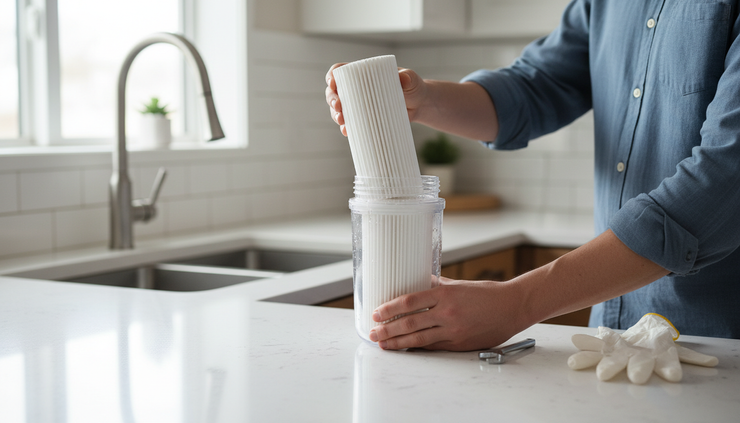
Set reminders for cartridge changes. Do not rely only on taste. Some contaminants have no taste at all, and a filter can stop working well before the water seems different.
Good maintenance habits include:
Change cartridges on schedule, or sooner if flow drops
Use genuine or compatible certified replacements
Wash jugs and reservoirs regularly
Keep filter housings clean
Replace UV lamps as recommended
Clean UV sleeves if the system uses them
Sanitise RO tanks when advised by the manufacturer
Check for leaks after every cartridge change
Retest water after major maintenance or supply changes
Filter life depends on water quality and usage. A large family can use up a cartridge faster than the stated time on the box. Sediment-heavy water can clog filters early. Hard water can reduce performance in some systems.
A filter protects the household only when it is matched to the contaminant and maintained on schedule.
Know when filtration is not enough
There are times when a home filter should not be the only safeguard.
If the water supplier issues a boil water notice, follow that advice even if a filter is installed. Many domestic filters are not designed to make unsafe water safe during an emergency.
Seek expert help if:
Water smells strongly of fuel, chemicals, or sewage
Water changes colour suddenly
Several people in the home become unwell after drinking it
Laboratory results show bacteria, high nitrates, lead, or other health-related contaminants
A private supply floods or the wellhead is damaged
Water pressure or flow changes with no clear cause
Bottled water may be needed for a short time during an urgent issue, especially for infant formula or vulnerable household members. Long term, the safer approach is to identify the cause and treat it properly.
A simple decision path
If the choices feel overwhelming, use this practical order:
Identify the supply
Mains water or private supply.
Gather information
Read the supplier report or arrange testing.
List the concerns
Taste, chlorine, lead, hardness, nitrates, bacteria, sediment, or another issue.
Match the technology
Choose carbon, reverse osmosis, UV, sediment filtration, softening, or a combination.
Check certification
Look for proof that the system reduces the specific contaminant.
Plan maintenance
Price the replacement filters and set reminders before buying.
Retest when needed
Confirm the system works, especially for private supplies or health-related contaminants.
Safe drinking water at home comes from a chain of good choices: testing, matching the filter to the problem, installing it correctly, and maintaining it on time. Start with the facts about the water in the home, then choose the simplest system that deals with the real risks.
A well-chosen filter can make daily drinking water taste better, support confidence in the kitchen, and reduce avoidable exposure to unwanted contaminants. The smartest first step is not buying a filter. It is finding out what the water needs.
Comments